

Courtesy of Jessica Bippen/Nourished by Nutrition
This article is from "One Small Change" by Jess Bippen, a registered dietician and Featured Voice, The Washington Post’s platform highlighting content from independent creators.
In this week's episode of One Small Change, we're talking about movement and why doing “less” more often might actually be better for your hormones than one long session.
The All-or-Nothing Trap
One of the biggest reasons I see women not staying consistent with exercise is because of the all-or-nothing mindset around it. It’s not laziness. It's the belief that if they can't do it all, there's no point in doing any of it. They can’t dedicate that hour (plus drive time to the class). They don’t have a gym. The kids woke up.They didn’t sleep well the night before. Unfortunately, the inconveniences get in the way of making due and the workout gets skipped altogether.
And there’s more to it than just simply a mindset block. For a lot of women, that hour-long workout when you're already running on empty is actually making things worse. When cortisol is already elevated from poor sleep, under-eating, or chronic stress, adding an intense workout can signal to the body it’s not safe. This causes cortisol to spike further. And you you finish the workout more depleted than when you started. It takes you longer to recover and then wonder why you’re not feeling those post-exercise endorphins, you’re exhausted vs. energized or not seeing the results you were hoping for.
What the Science Actually Says
If this sounds like you, doing more isn’t the answer. You don’t need an hour-long workout or an intense session to benefit.
In fact, shorter bouts of movement distributed throughout the day have been shown to be just as effective as one longer session for blood sugar regulation, cardiovascular health, and metabolic function. For hormone health specifically, this can be very helpful. Doing shorter circuits of movement can help keep cortisol response manageable and avoid the prolonged elevation that comes from intense workouts when you’re already depleted.
I find this also helps with consistency. Because you don't need a 60-minute time block, a gym, or childcare to make it happen, it feels much more do-able. A free ten to fifteen minutes exist almost every day, multiple times a day, even the busy ones. And they add up! Short 10 minutes of movement three times a day adds up to thirty minutes of movement that actually fits your life.
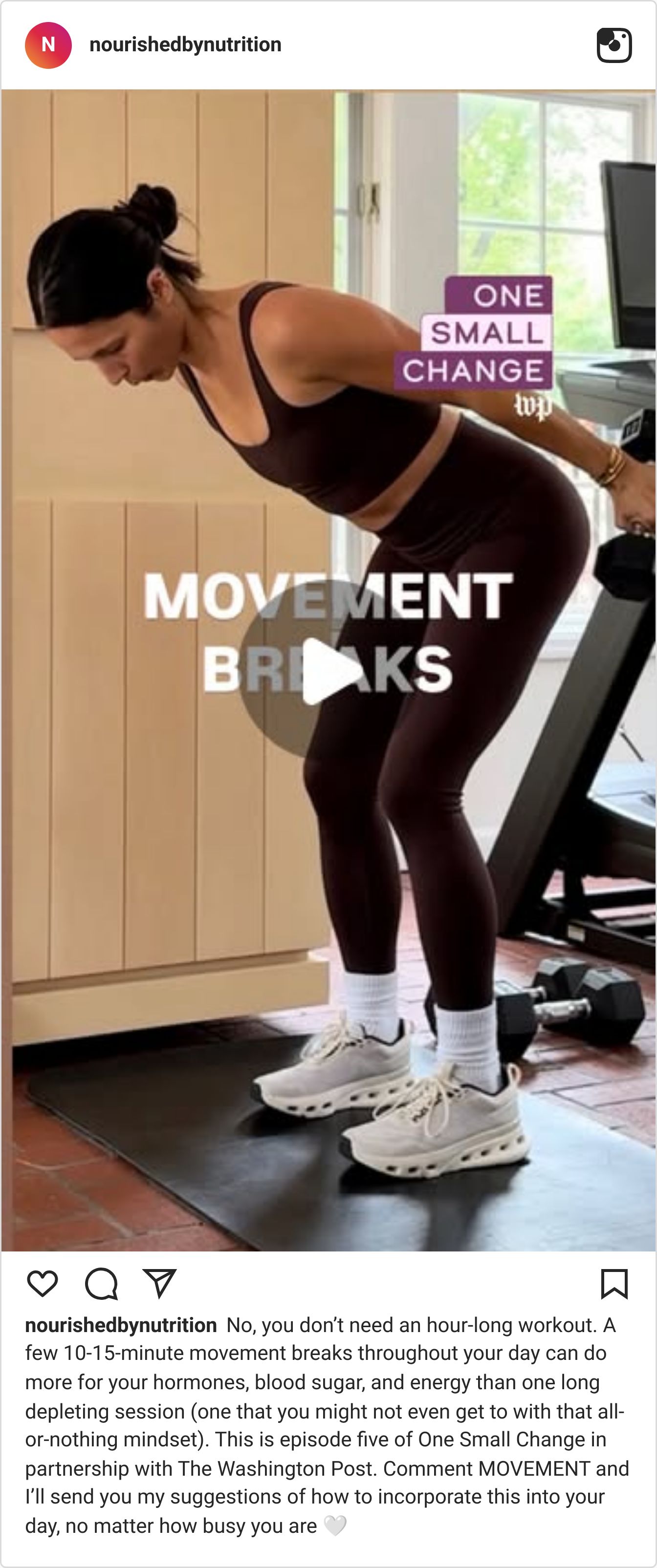
The One Small Change: Three Movement Breaks
Instead of focusing on one long workout, try three intentional “movement breaks” throughout your day. One in the morning, one midday, and one in the evening. It can be as simple as walking after your meals or doing something more intentional weight or body weight circuit.
Here’s some examples to get started.
Morning — 10 to 15 Minutes
Why it matters: Cortisol is naturally elevated in the first hour or two after waking as part of your cortisol awakening response. A short burst of movement in the morning works with that natural peak instead of fighting it. It also activates your muscles and helps stabilize blood sugar which sets your energy and focus up for the rest of the morning.
Beginner circuit:
Bodyweight squats x 10
Glute bridges x 12
Wall push-ups x 10
Reverse lunges x 8 each side
Bent knee drops x 10 each side
Rest 30 seconds, repeat 2 rounds
Moderate circuit:
Squats x 15
Glute bridges with hip thrust hold x 12
Push-ups x 10
Reverse lunges x 10 each side
Dead bugs x 10 each side
Rest 30 seconds, repeat 3 rounds
More active circuit:
Jump squats x 12
Single leg glute bridges x 12 each side
Push-ups x 15
Walking lunges x 12 each side
Dead bugs x 12 each side
Rest 20 seconds, repeat 3 rounds
Midday — 10 Minutes After Lunch
Why it matters: This is one of the most underrated blood sugar tools. A 10-minute walk after eating can significantly blunt the post-meal blood sugar spike and helps your body use that glucose for energy rather than storing it. Research shows walking for just 10 minutes after a meal can reduce blood sugar by up to 20%.
What this looks like: A walk around the block. Laps in your backyard. Multitasking while putting away clothes or doing a quick house pick up. Walking while you take a call. It doesn't need to be a programmed workout, just some type of movement.
Evening — 10 Minutes After Dinner
Why it matters: It’s the same blood sugar benefit as the midday walk. By walking after a meal you're blunting the post-meal spike and helping your body use what you just ate. But the evening walk has an added bonus. Low-intensity movement in the evening helps lower cortisol before bed, which supports deeper sleep and better overnight recovery. It's one of the simplest sleep tools most people aren't using.
What this looks like: A walk around the neighborhood. A walk the kids or the dog. It doesn’t have to be intense or structured. Just gentle movement that signals to your nervous system that the day is winding down.
What This Look Like for Me
As much as I wish I could dedicate more time to a longer structured workout, in this season of life it’s often modified into movement breaks. Sometimes 10-15 minutes sometimes a little longer 20-30 minute timeframes. Sometimes it’s only one or two sessions (not three) and I’ve learned to be okay with that.
It all still counts. Because to me consistency over time matters more than striving for the perfect workout scenario (that wouldn’t even happen) every day.
Morning — 15-30 minutes
This often looks like a walk around the block with or without a little one depending on when they get up. And if I have time, a weight or session. If I only have 15-20 minutes I’ll try to get in the weight session and walk after the kids get dropped off.
Mid-day – 15-30 minute
This is a walk around the neighborhood. Sometimes I’m answering emails, making phone calls, scheduling appointments or editing content. Other times, I stay off my phone and just walk without distractions.
Evening – 0-15 minutes
This part of the day is the hardest for me because it’s pick up, practices, dinner, getting the kids ready for bed and family time. But If it’s nice and there’s no practice I encourage a family walk while the kids bike or scooter. I also try to walk while I’m at my kid’s practice. Instead of sitting in an ice rink for an hour, I walk around the rink for part of the time.
This is episode six of One Small Change in partnership with The Washington Post. Each episode focuses on one simple shift that creates a real, measurable difference. Find all previous episodes linked below.
For a deeper dive into blood-sugar science, exclusive recipes, and weekly meal planning ideas, subscribe to Jess’s newsletter on Substack and follow along for step-by-step video reels on Instagram.

This story is part of Featured Voices by Washington Post Creator, a team outside The Washington Post’s newsroom. Featured Voices highlights content from our network of independent creator who share their expertise, perspective and stories with The Washington Post.
