

This article is from "One Small Change" by Jess Bippen, a registered dietician and Featured Voice, The Washington Post’s platform highlighting content from independent creators.
If you’ve ever finished a sweet treat and immediately felt a sudden drop in energy an hour later — leaving you reaching for another cookie — it isn’t a lack of willpower. It’s standard human biology.
When you consume refined sugar without any buffering nutrients to slow down digestion, your body releases a rapid surge of glucose into the bloodstream. In response, your pancreas releases insulin to bring those levels down. Without fiber or protein to steady the process, the system can overcorrect, dropping your blood sugar lower than where it started. That sudden plunge is what leaves you feeling fatigued, foggy, and craving another quick sugar boost.
The solution isn't cutting out dessert entirely; total restriction often backfires. Instead, focus on strategic ingredient upgrades when making treats at home.
Adding two key nutrients — protein and fiber — slows down how quickly glucose enters your bloodstream. This produces a gentler insulin response and a softer landing, keeping your energy stable. Swapping regular flour for almond or oat flour, using whole-food sweeteners like dates, or blending in Greek yogurt or protein powder are simple ways to buffer your sweets without compromising on flavor.
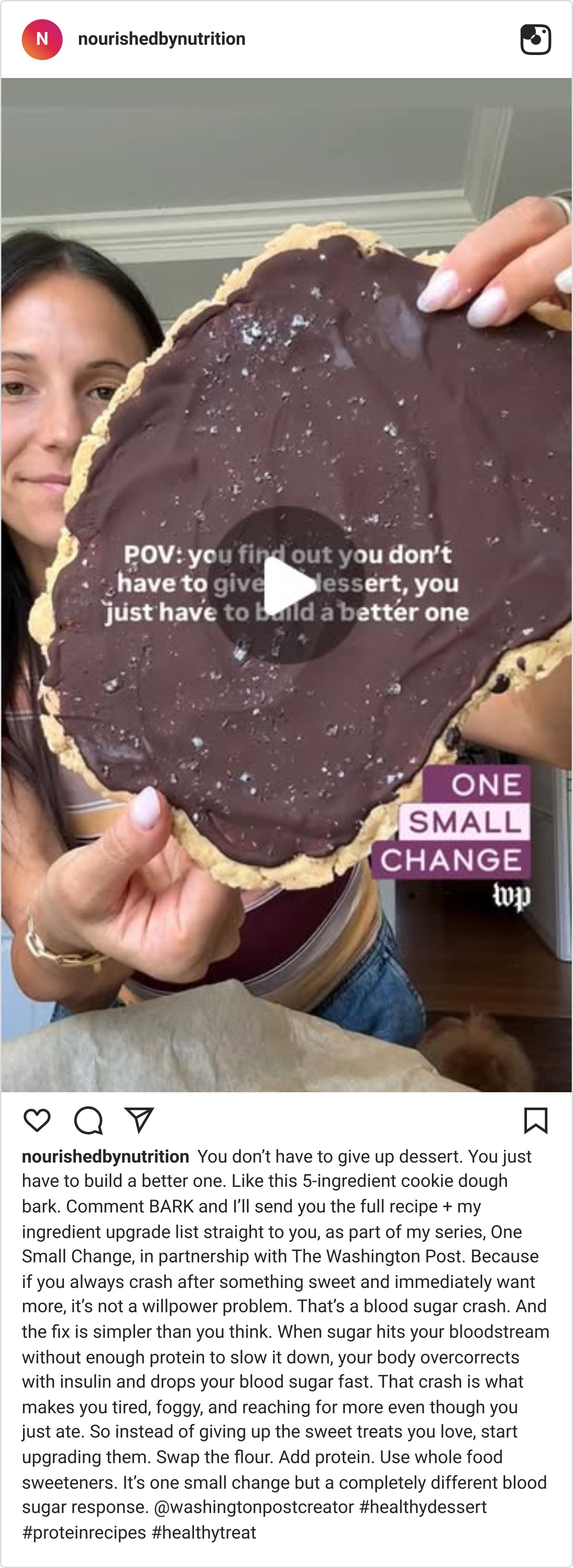
This High-Protein Cookie Dough Bark is a great example: it offers the classic, nostalgic flavor of raw cookie dough while using Greek yogurt and almond flour to keep blood sugar steady.
Active time: 15 minutes | Total time: 45 minutes
Yield: 12 to 16 pieces
This frozen treat delivers the rich flavor of chocolate chip cookie dough with an upgraded nutritional profile. Greek yogurt and almond flour supply protein and healthy fats to buffer the natural sweetness of maple syrup.
Ingredients:
1 cup almond flour
½ cup vanilla protein powder
¼ cup plain Greek yogurt (see note)
¼ cup pure maple syrup
½ cup mini dark chocolate chips, divided
½ to 1 teaspoon coconut oil
Flaky sea salt, for topping
Directions:
Make the base: In a medium bowl, combine the almond flour, protein powder, Greek yogurt, and maple syrup. Stir with a spatula until a cohesive dough forms. If the mixture feels too dry, stir in additional Greek yogurt 1 tablespoon at a time. (Note: The exact moisture needed will vary based on your protein powder brand.)
Add chocolate: Fold ¼ cup of the dark chocolate chips into the dough.
Shape: Line a small baking sheet or rimmed dish with parchment paper. Transfer the dough to the pan and press or roll it into an even layer, about ¼-inch thick.
Melt the topping: In a small, heatproof bowl, combine the remaining ¼ cup of chocolate chips and the coconut oil. Microwave in 30-second bursts, stirring between each, until completely melted and smooth.
Assemble and chill: Pour the melted chocolate over the dough layer and spread it evenly to the edges. Sprinkle lightly with flaky sea salt. Freeze for at least 30 minutes, or until the chocolate layer is completely set.
Serve: Break or cut the bark into 12 to 16 pieces. Serve immediately, storing any leftovers in an airtight container in the freezer.
Note: Almond milk or coconut oil can be substituted for the Greek yogurt if necessary, though the protein content will be lower. The Greek yogurt provides the primary protein structure that makes this treat blood-sugar friendly.
Macros (for 12): 165 kcal, 10g fat, 13g carbs, 6.5g protein, 2g fiber, 10g sugar
For a deeper dive into blood-sugar science, exclusive recipes, and weekly meal planning ideas, subscribe to Jess’s newsletter on Substack and follow along for step-by-step video reels on Instagram.

This story is part of Featured Voices by Washington Post Creator, a team outside The Washington Post’s newsroom. Featured Voices highlights content from our network of independent creator who share their expertise, perspective and stories with The Washington Post.
