

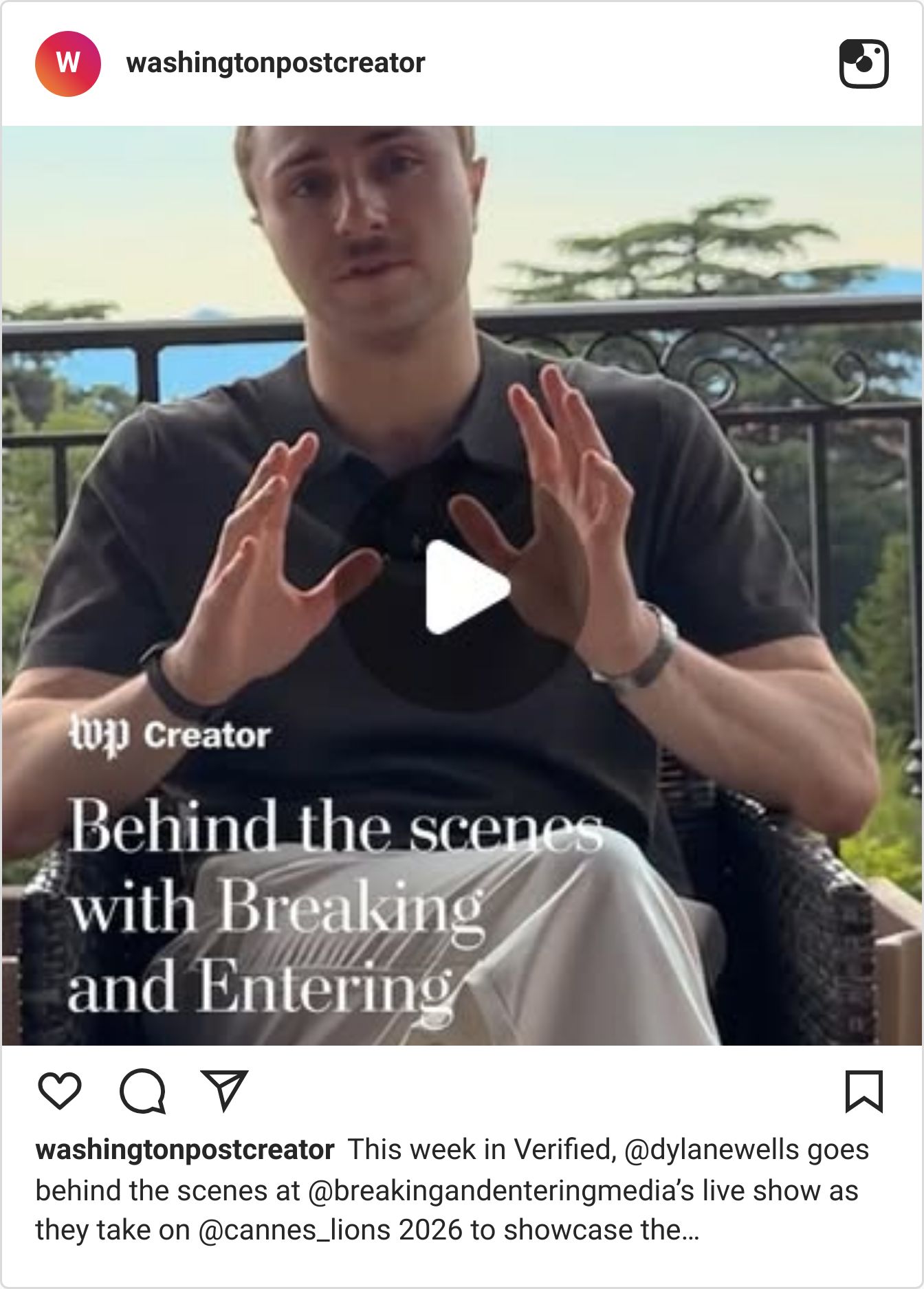
Photo courtesy of Dylan Wells for The Washington Post
CANNES, France — As megacreators and traditional celebrities descended on Southern France to mingle with advertising industry executives and C-suite leaders of top brands, it was a nontraditional creator duo with less than 100,000 followers across platforms that chief marketing officers were gushing over.
Cannes Lions was the Super Bowl for live show Breaking and Entering, a channel focused on the ad business that streams three days a week and features interviews with industry guests — which the key players at Cannes Lions were eager to appear on.
Take Jessica Jensen, the CMO of LinkedIn, who left an event with Oprah to kick off Breaking and Entering’s Wednesday live show, filmed from the secluded COLLINS House, far from the craziness of La Croisette, and featuring leaders from Kraft Heinz, PepsiCo, Pinterest, Coinbase, Levi Strauss & Co and Chipotle. During her segment, Jensen and Breaking and Entering co-founders and hosts Geno Schellenberger and Jack Westerkamp sang “Sweet Caroline,” Jensen pretended to choke Westerkamp and said she’d wear the show’s branded merch.
“Their shows and the content they produce are insightful, condensed and hilarious. So you get actual ad industry news quickly with humor. It's magic,” Jensen told me after stepping off set. “They are real, they know what they're talking about, they actually know the industry, they understand marketing and advertising, and they ask great questions. They make it fun.”
While many of this year’s Cannes Lions panels featured a token megacreator, and many creators operated on a different track than the festival’s awards and official programming, Breaking and Entering provided an outlet for top winners and people actually working in the advertising space.
“This is all out of love for the ad industry, like the people behind it, the ad agencies, the people that are putting marketing out in the world,” Schellenberger said in an interview before the show.
Breaking and Entering started as a pandemic-era podcast project Schellenberger launched post grad and ran for four years before bringing on Westerkamp, his childhood best friend. They then moved the show to New York and started streaming from a one-bedroom apartment after raising $53,000 from friends and family. They realized they were onto something when industry leaders like Anselmo Ramos, the co-founder of GUT, were willing to come to their East Village apartment to sit on a futon and shoot the interview podcast.
“These executive leaders that are giving us access and allowing us to interview them clearly are gravitating towards it or see something, some value with it, because he's not going to show up to like the shittiest apartment you've ever been to if he didn't think or believe that like the content that was happening was worth it or was valuable either for GUT the agency, or himself,” Westerkamp said.
Breaking and Entering is also emblematic of the power of niche audiences, as some creators increasingly focus on the type of viewers rather than number, particularly as algorithmic platform changes make it challenging for even top creators to reach their followers.
“There's a lot of dollars that flow through this niche, it's very powerful, affects a lot of budgets. So for us it's staying here, what we're passionate about, it makes no sense for us to go and expand off into, like, finance,” Schellenberger said.
The format of the live show itself is less about attracting viewers — their CMO-focused live interview show last week has just over 430 views on YouTube — and more about efficiency and material for clipping and sharing.
“Getting live viewership is extremely hard. … That's not the goal right now. We want to make the live show experience as good as humanly possible, but the goal is to efficiently get as much content that's great content that's up to our standard as possible in a short amount of time,” Westerkamp said. Plus, from an advertising perspective, “it allows for a ton of integration into the show and all the content that comes from it.”
Their primary revenue is from sponsorships, which they approach from a media-company perspective rather than as creators. They predict in the future, brands will be looking for a media buy rather than a traditional promotional campaign deal.
They considered consulting and producing content for brands, but ultimately chose to concentrate on themselves. “That didn't work for us, so when we doubled down on our own content and found things that worked and expanded on that and focused on really good content. The money comes, the sponsors come after that,” Schellenberger said. “Content first, and then dollars will come in, and then it's just reinvesting it into the people.”
After “six years of consistently interviewing the best of the best … we have earned their trust, and we don't take that for granted, and they show up, we treat them well, we celebrate them, we ask them deep questions, we poke when we need to poke, and push when we need to push,” he added. “That's what we can do here at Cannes, and bring that back home to our audience, who cares about this stuff too.”
This story is part of Verified, a newsletter that is published by Washington Post Creator, a team outside The Washington Post’s newsroom that is focused on the creator economy and content partnerships with independent creators. Learn more about Washington Post Creator.
