

Hello from Boston, where I’m speaking today at The Boston Globe’s Globe Summit about why brands are betting on creators. It’s not too late to register to attend virtually for free to livestream today’s programming.

Photo by Lancer Photography for The Washington Post
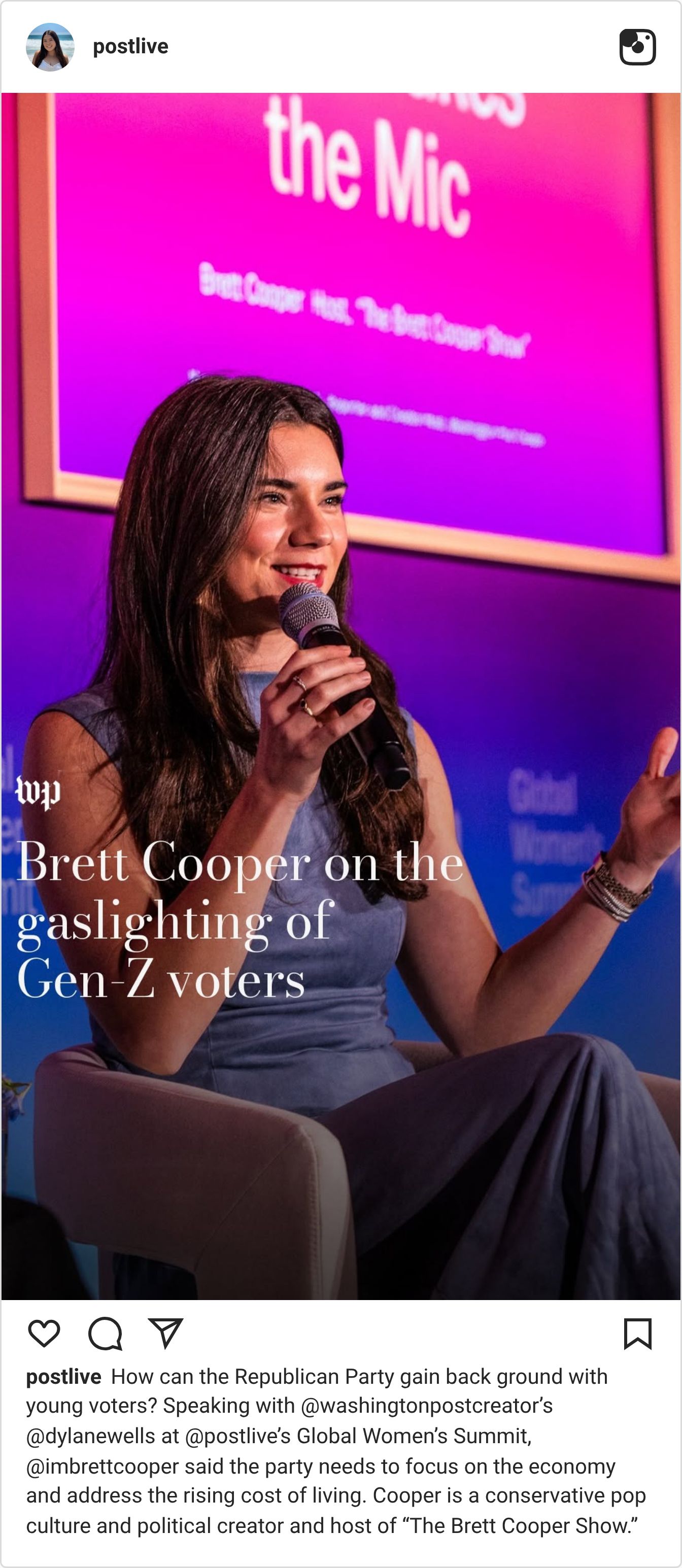
Creator Q+A: Brett Cooper
Brett Cooper (@imbrettcooper) is a conservative political commentator and the host of “The Brett Cooper Show.” This interview has been edited and condensed.
Dylan Wells: Let's talk about creator roles in the midterms and in 2028. A report last month from Syracuse University’s Center for the Creator Economy found that YouTube edged out traditional TV as the top source for political news. Where do you see the role of creators in our elections?
Brett Cooper: We are the vehicle, really. … The media landscape has changed so much over the last 20 years where people are no longer sitting down in front of their TVs and turning on news and getting a constant stream of news media throughout the day. People are also very, very interested in authenticity and they want to hear from people that they trust. And usually, it is influencers and podcasters and people who are speaking to them every single day and being vulnerable and sharing parts of their lives with them that obviously builds that trust. And so as a result, I think that people are more inclined to trust people online that they have that kind of parasocial relationship with people.
DW: The Post’s polling showed that voters under 30 broke overwhelmingly for Democrats, two to one among 18- to 24-year-olds and 60 percent among those 25 to 29. That was a big shift from 2024. How do you think the Republican Party can gain ground back with young voters?
BC: First thing, to stop gaslighting us, I think that is a big thing. The results of the midterms were wholly unsurprising to me. There were a lot of conservatives who were online, and they were saying, “Just look at 2024, we're going to have this massive red wave. Everybody's going to come out and vote for us. Promises made, promises kept,” the whole thing. That is not what I saw in my real life. That is not what I saw in polling.
In terms of what Republicans can do, it really is the economy. You have two years to try and turn it around and to do the things that you promised people. I think the economy and reducing corruption, because I look at our bureaucracy and I see so much bloat. I see so much misuse of our hard-earned tax dollars. And whichever political party is able to trim the fat and put more money back in Americans' pockets and truly focus on America first, that's a really, like hot little slogan that people use these days, but it truly is. Americans want our country to be put first and they want to be put first, and so I think that is what Republicans need to focus on.
I also think that they need to listen to young voters a little bit more. I think that that is something that both the left and the right have an issue with, is that they talk down to young people and they talk down to Gen Z struggles. And they say, just like work a little harder, you will be able to afford a house one day. And you are going to inherit our wealth one day, so do not worry about it. It's like, well, right now you have young people that are getting married and they are choosing not to have children because they think that they can't afford it, because they think that they'll never be able to buy a home and you just wagging the finger and laughing at them is completely unproductive. So, I think it really all goes back to the economy.

The Takeover: How creators flexed their power this week.
Hearst Magazines launches a creator studio built like a talent agency (AdWeek)
Winning candidates appeared on more podcasts (Axios)
NowThis acquires Impact Media in ‘seven-figure’ deal (AdWeek)
Higher Ground’s “The Eyes Of Ghana” sets global release on IShowSpeed’s YouTube channel (Deadline)
Druski brings “SNL” 5.6 million viewers, its biggest audience in two years (Variety)
Hank Green is self-funding ClockwiseTV, a curated educational video platform for kids (Tech Crunch)
The Bulwark joins Vox Media's podcast network (Axios)
“I love being a girl”: Inside the life of a sorority influencer (New York Times)
What products and services do health and wellness influencers promote? (Pew Research)
Half of U.S. adults surveyed made at least one creator-recommended purchase last holiday season (Syracuse University)
Global Women’s Summit: A conversation with Anjali Sud, CEO of Tubi

Photo by Lancer Photography for The Washington Post
Last week, Washington Post Creator president Sara Goo sat down with Tubi CEO Anjali Sud at The Post’s Global Women’s Summit in New York City. Sud has emerged as a leader in digital media, first as CEO of Vimeo and then at the helm of Tubi, the free, ad-supported streaming service.
Sud was also just named the incoming CEO of SiriusXM, a role she’ll start in January. Here are excerpts from the interview, where Sud shared her thoughts on creators, the future of media and being part of the small club of female CEOs.
On her transition from CEO of Tubi to her new role:
“I don't think I have ever felt ready for any big job. I have always tried to put myself outside of my comfort zone. I feel like when I am out of my comfort zone, it's when I grow the most and I learn the most. And I do thrive in that environment. So that is definitely kind of a part of it. And I think the other part is something I have learned over the years, which is I think the most enduring thing a leader can build is a team and a culture that can succeed without them. And I am so proud and happy that Tubi is just a rocket ship right now, and the team and the culture are so strong that it did feel like the right time for me to go and get out of my comfort zone again, knowing that that company and that mission and that team were rocking.”
On how Tubi is changing entertainment with what Sud calls “niche is core” strategy:
“We sometimes say internally at Tubi, ‘we are trying to break the monoculture.’ But really what that just means is if you think about sort of the media system, traditional Hollywood, for so long, everyone in America would tune in at 8 p.m. to watch the same show. So, the show that is being made is being made for everyone.
And now we live in a world where everything is on demand, and everything is personalized. And what does that mean? It means that if you are me and I want to see and go down a rabbit hole of a ton of content that sort of is reflecting my lived experience, there is actually content out there that is being made often by independent filmmakers or creators — and so how do we help those stories find their unique audience?
And so what we like to say is, is ‘niche is core.’ And what used to be seen as niche in a negative way, we see as actually all of us are in many ways. We have our unique tastes. And because we now have this on-demand personalized way of consumption, it means that every story can find its audience and every fan can feel uniquely seen by content.”
On being a female leader:
“What I have found from my experience is that passion is my path to being me, sort of authenticity. It's my path to confidence, to being brave. Because like when I just believe in something, I am much more willing to just say what I think.
And it has enabled me to be in these positions where other people are willing to bet on me. And so I always bet on passion in other people. And I think as women trying to find our way in corporate America and trying to chart our own paths, my advice is always, like, find something you are just so passionate about, you cannot keep your mouth shut.”
The Platforms:
Instagram is bringing affiliate links directly to reels and posts and adding content protection
X added a feature to clip in app, with both clipper and original creator earning on views
Substack launched new website design tools
Pinterest released an inaugural list of “Creators to Watch”
EU targets social media addiction and online “dark patterns”
Italy fines Meta $887M for accessing Android users’ photos
Got a creator story? Drop us a line by replying to this email, or follow me at @dylanewells. If this email was forwarded to you, click here to subscribe.
